

Employee Benefits Can Save You Money
In this highly competitive market, a few thousand or even a few hundred dollars in your bid can be the difference between winning a large public works construction contract and laying-off employees. That's why a prevailing wage employee benefits strategy can help your company. Depending upon the state you live in, you might be wasting an additional $0.30 for every $1 dollar of fringe benefit money you pay to the employee as wages. That may not sound like much. BUT, for a large public works project, you might be paying thousands of dollars in taxes – THOUSANDS! – that you don’t need to be spending.

Lower Your Job Costs
Use the mandatory fringe benefit payment to reduce payroll tax burdens, lowering your job costs. It really is that simple.

Care For Your Crew
Give them meaningful employee benefits that will be there for them when they need them. Prevailing wage employee benefits matter.

Be More Competitive
Develop more competitive bids, lower your operating expenses or just take better care of your crews.
What Our Clients Say About Us
"From the beginning, with their (CPWIS') instructions on how to set-up our benefits and select correct Prevailing Wage Determinations, we were able to save money. Their assistance has been invaluable."
-Kym Burns, Land Mark Electric
Let us Show You How we Can Help
It may seem too good to be so, but it's true. Employee benefits strategies can take all that fringe money off of payroll, saving you money AND give your employees a meaningful benefit. Prevailing Wage employee benefits can help your prevailing wage business grow - let our employee benefits consultants show you how!
Prevailing Wage Fringes Are Employee Benefits, Not Wages
When you put the mandatory fringe portion of the prevailing wage on your employees’ paychecks, your fringe payments are being treated as wages; and since they're wages, you are required to pay statutory taxes and workman’s compensation. That’s right, you are paying taxes on your fringe benefit!
Can You Afford To Be Paying Extra For Your Fringe (Example)
In California, an August 22, 2012 Wage Determination had a journeyman Asbestos Worker, Heat and Frost Insulator in Area 1 paid a Total Hourly Rate of $73.37. But, of that $73.37 rate, only $54.70 is hourly pay. The remaining $18.67 is allocated as fringe benefit money. Which means, if you get all of that fringe money off of payroll, then the total hourly rate becomes... $54.70. Let's see how the two compare on a weekly basis.
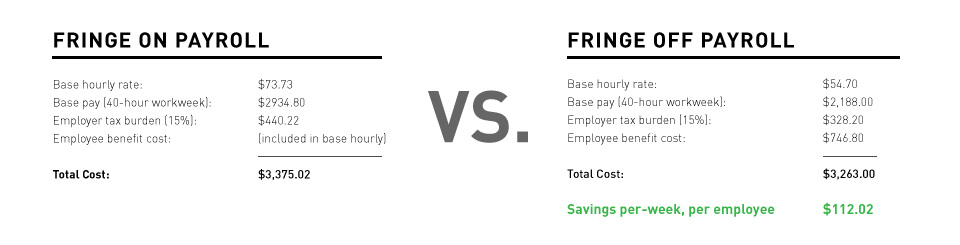
Save $112.02 per employee, per week by simply providing the fringe benefit as intended, instead of paying the fringe in cash. That's free money back to your company, and that's why taking the fringe portion of your prevailing wage payroll is so important. By using fringe money for what it's intended for - providing an employee benefit - you can take care of your employees AND help your bottom-line.
Payroll Savings Are Only The Beginning
Every employer knows that G/L and Workman's Comp premiums are determined by payroll. Lower your payroll, lower your premiums. Consider those lower premiums, along with the reduced payroll burden, and you can see how the annual savings from taking fringe benefits off payroll can really add up - to $150,000 or more for a 50 employee company!
We Really Can Help Lower Your Job Costs
Take a look at the ways our prevailing wage employee benefits consultants help, or reach out and talk with us. Let us show you how our employee benefits strategies can help your business be more successful!
Strategies For Moving Prevailing Wage Fringe Money Off Of Payroll
By creating prevailing wage employee benefits packages your field-employees will value, we help you keep your staff happy. And who doesn't want people to be happy? The key to getting prevailing wage fringe money off of our clients' payroll is putting it into "bona fide" fringe benefits. By designing employee benefits plans that eliminate both tax liabilities and workman's comp costs, Contractors Prevailing Wage can substantially reduce your operating costs.
Our Employee Benefits Really Can Help
Take a look at the ways we can help lower your job costs, or just reach out and talk with us. Let us show you how taking care of your people can make your business be more successful!